Export Operations Overview
Find out what your business needs to do during exportation of goods from Singapore in this essential guide, which covers registration, controlled goods checks, export permits and cargo clearance.
Last updated 24 February 2026
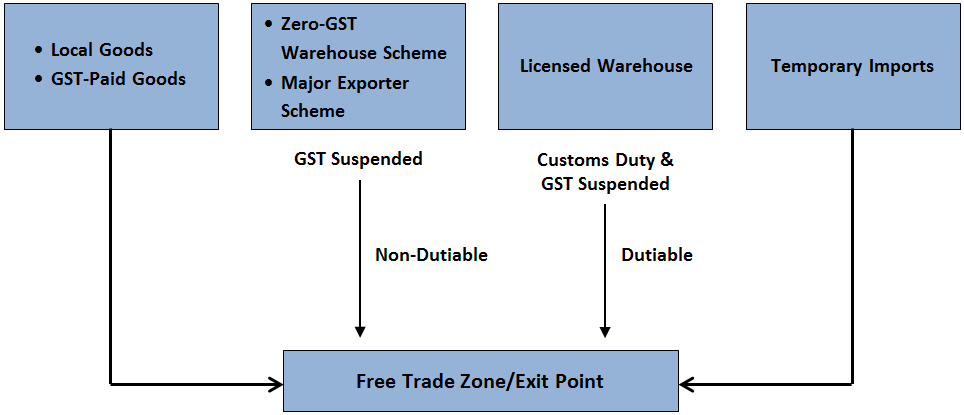
General Export FlowChart
Exporting goods from Singapore is straightforward if you follow the right steps. This guide walks you through the export process, from registration to cargo clearance.
Exporting Goods in General
All exports from Singapore are regulated by several laws, including the Customs Act, the Regulation of Imports and Exports Act, and the Strategic Goods (Control) Act, as well as by rules issued by the relevant Competent Authorities (CAs).
GST and duty are not charged on goods exported from Singapore.
However, you must still declare all exports to Singapore Customs and obtain the correct permits.
How to Export Your Goods
Whether you are exporting from a customs territory, a licensed warehouse, a Zero-GST warehouse, or under special schemes, follow these five key steps:
Step 1: Register for UEN and Activate Your Customs Account
Before you can export, your business must:
Register with the Accounting and Corporate Regulatory Authority (ACRA) or the relevant UEN-issuing agency to obtain a Unique Entity Number (UEN)
You need this if you plan to:
Import or export goods in Singapore
Apply for import, export, or transhipment permits or certificates
Step 2: Check if your goods are controlled
Some goods require approval from Competent Authorities before they can be exported.
You should:
Check your goods using their description, HS code, or CA product code
Confirm licensing or authorisation requirements directly with the relevant CA if the goods are controlled
If you are unsure of the correct 8-digit HS code, you can apply for an official classification ruling for S$75 per product. These rulings apply only in Singapore.
Step 3: Apply for a Customs Export Permit
You can:
Appoint a declaring agent to handle the permit application for you, or
Apply for permits yourself. You will need to register as a declaring agent and obtain a TradeNet user ID
All export permit applications must be submitted electronically via TradeNet, using:
A TradeNet front-end solution from an approved service provider, or
However, do note that declaring agents may charge service fees. Fees can vary, so check costs upfront. Refer to Permits, Documentation and Other Fees for more information.
Step 4: Prepare Documents for Cargo Clearance
Export permits are issued with a validity period. Always ensure your permit is valid at the time of clearance.
You must present the permit and supporting documents when required by the permit conditions, or when exporting dutiable or controlled goods.
1) Containerised Cargo
For containerised shipments, be ready to produce:
Approved Customs export permit
Commercial invoice
Packing list
Bill of Lading (BL) or Air Waybill (AWB)
You must also provide the permit number at the point of cargo lodgement.
Example of conditions in the permit indicating this requirement:
A2 | Produce the following at a Free Trade Zone ‘Out’ Gate for Customs clearance/endorsement:
Unless it is directed to the ‘Green Lane’ at the time of clearance. |
H1 | Produce the following at Woodlands Checkpoint/Tuas Checkpoint for Customs clearance/endorsement:
|
A3 | Produce the following at an Airport Customs checkpoint or designated Customs office:
|
A Customs export permit is required for:
Dutiable goods from licensed warehouses
Goods from bonded warehouses
Goods under the Temporary Export Scheme
Re-exports under the Temporary Import Scheme
2) Conventional Cargo
For conventional cargo, the requirements are the same:
Approved Customs export permit
Invoice
Packing list
Bill of Lading
You must present the permit number at cargo lodgement for verification purposes.
Example of conditions in the permit indicating this requirement:
A2 | Produce the following at a Free Trade Zone ‘Out’ Gate for Customs clearance/endorsement:
Unless it is directed to the ‘Green Lane’ at the time of clearance. |
H1 | Produce the following at Woodlands Checkpoint/Tuas Checkpoint for Customs clearance/endorsement:
|
A3 | Produce the following at an Airport Customs checkpoint or designated Customs office:
|
A Custom Export permit is required for:
Dutiable goods from licensed warehouses
Goods from bonded warehouses
Goods under the Temporary Export Scheme
Re-exports under the Temporary Import Scheme
Important
Partial clearance is not allowed for cargo departing via Woodlands or Tuas checkpoints. Submit one permit per container or vehicle.
Step 5: Keep Your Trade Records
Businesses must retain all supporting documents related to the purchase, import, sale, or export of goods for at least five years from the date of permit approval.
You may store records as:
Physical hardcopies, or
Digital images
You must be able to produce these documents to Singapore Customs upon request.