Inspections
Facilities which conduct specific activities involving scheduled chemicals and unscheduled discrete organic chemicals are subject to inspections conducted by the Organisation for the Prohibition of Chemical Weapons. You will learn more on the type of inspections, notification timelines, inspection stages, and what facilities need to do to prepare and remain compliant.
Last updated 25 February 2026
Facilities producing, processing, or consuming scheduled chemicals or producing Unscheduled Discrete Organic Chemicals (DOCs), are subject to inspections under the Chemical Weapons Convention (CWC).
Types of Inspections / Site Visits
Under the CWC framework, inspections may be conducted by the Organisation for the Prohibition of Chemical Weapons (OPCW). These inspections verify that declared activities are in accordance with the obligations under the CWC and consistent with the information provided in declarations. The National Authority (CWC) [NA(CWC)] will also conduct site visits for licence application and compliance-related purposes.
Pre-Licence Site Visit
This is conducted by NA(CWC) to:Verify the information declared in a facility's licence application; and
Inform the facility about the preparations required for an OPCW inspection.
Site Visit
This is a site visit conducted by NA(CWC) to:Confirm ongoing compliance with CWC licence conditions and verify accuracy of declared activities and facility details to NA(CWC); and
Inform the facility about the preparations required for an OPCW inspection.
Routine Inspections
Declared facilities with production, processing, or consumption levels that exceed verification thresholds (see below) are subject to routine site inspections by OPCW inspectors.
Facilities subject to routine OPCW inspections
Type of Facility | Verification Threshold Limits |
Schedule 1 | All declared facilities |
Schedule 2 | Produced, processed, or consumed during any of the past 3 calendar years or anticipated next calendar year: |
Schedule 3 | Produced in the previous calendar year or anticipated to produce in the next calendar year more than 200 tonnes (aggregate) of any Schedule 3 chemical |
DOCs | Produced more than 200 tonnes in the previous calendar year |
These inspections are cooperative in nature and are not investigative.
Challenge Inspections
Challenge inspections are conducted to address concerns or requests for clarification regarding non-compliance with the CWC.
Member States must accept challenge inspections and cooperate fully by providing access and evidence to demonstrate compliance with the CWC.
OPCW Inspection Process
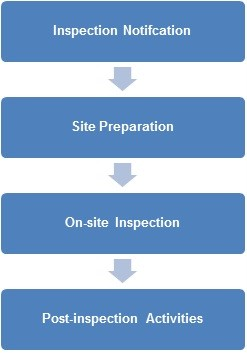
Overview of the OPCW inspection process, from notification and site preparation to on-site inspection and post-inspection activities.
OPCW inspections are conducted to verify that chemical activities are in accordance with the obligations under the CWC and consistent with the information provided in declarations.
OPCW inspectors are employed solely by the OPCW on a contractual basis and represent the OPCW during each inspection mission to the inspected Member State.
Inspection Notification
Once the OPCW schedules an inspection, NA(CWC) will notify the selected facility promptly. This notification will include:The purpose of the inspection
The expected inspection period
The number of OPCW inspectors and accompanying NA(CWC) officers
The notification period and inspection duration vary depending on the type of chemical at your facility.
Table of the schedule, notification period and their duration
Schedule | Notification period | Inspection duration |
1 | ≥ 24 hours | As required |
2 | ≥ 48 hours | ≤ 96 hours |
3 | ≥ 120 hours | ≤ 24 hours |
DOCs | ≥ 120 hours | ≤ 24 hours |
Site Preparation
Once notified, facilities should begin preparation promptly. NA(CWC) will support this process by conducting a preparatory visit to:
Confirm inspection readiness
Clarify inspection scope and requirements
Address operational or procedural questions
On-site Inspection
During the inspection, OPCW inspectors and NA(CWC) officers will work with your facility representatives in a structured and transparent manner. The inspection may include:
An introductory briefing on your facility’s operations
A guided site tour covering areas such as reactors, waste treatment area, warehouse, maintenance workshops, laboratories and medical facility
Review of records related to declared activities
Sampling and analysis, where required, to confirm the absence of undeclared scheduled chemicals
Throughout the inspection, NA(CWC) officers act as intermediaries between the OPCW inspectors and the facility representatives to ensure confidentiality of the facility’s information and compliance with Singapore’s obligations under the CWC.
Post-Inspection Activities
After the inspection:
The OPCW will share a draft of the preliminary findings report with NA(CWC) and the facility for review and clarification
All documents and materials provided during the inspection will be returned to the facility
The OPCW will provide a final inspection report to the NA(CWC) and the facility for review